Blog
How a Folding Door Changes the Way You Host a Backyard Party
Eleven people at my last backyard party, and not one of them stood in the doorway doing that awkward shoulder-turn shuffle. That was the night I stopped thinking of a patio door as an opening and started thinking of it as a room configuration.
If you host a few times a year, you already know the real bottleneck is never seating. It's the narrow gap between kitchen and yard, where trays pass sideways and someone always loses a drink. Wider openings solve that, and that's the whole case for exterior folding doors. They stack out of the way instead of sliding past a fixed pane, so the wall becomes optional.
Below, you'll get the
hosting case for that change, a walk-through test you can run this weekend with
your current door, and an honest split on when this upgrade is worth your money
and when it absolutely isn't.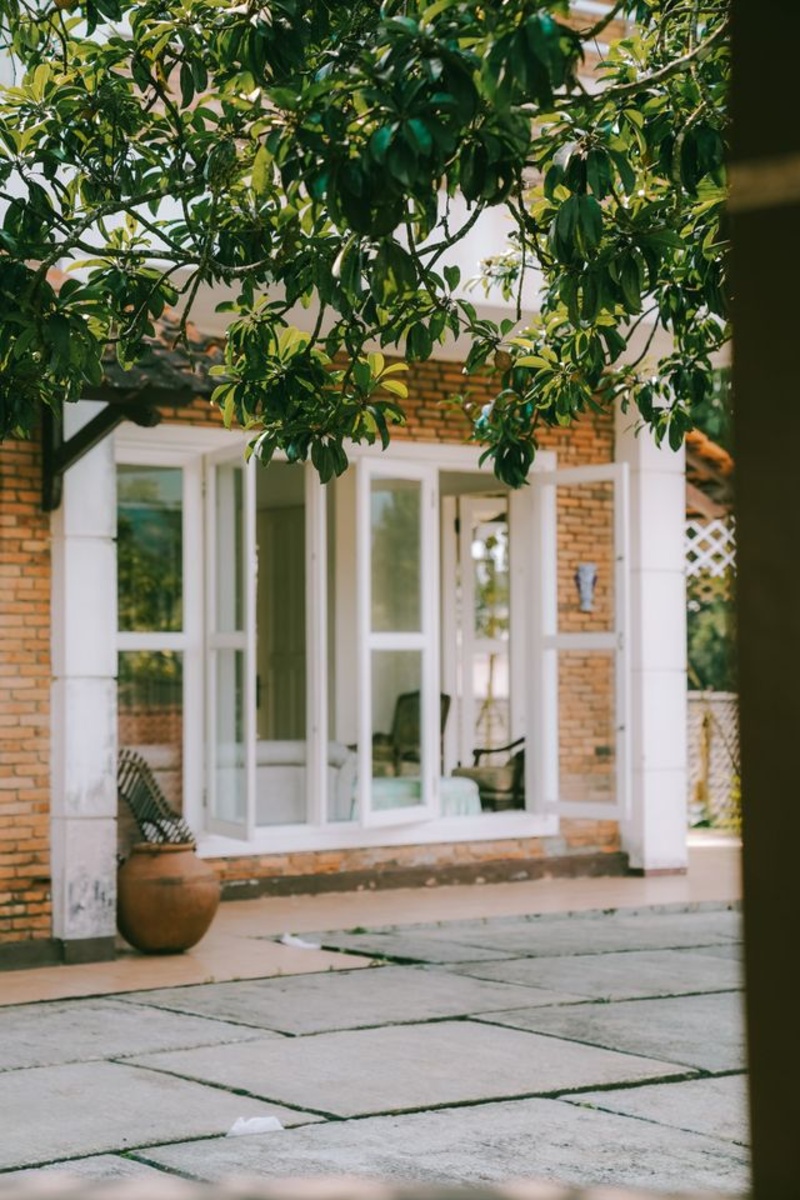
Photo by el jusuf
What actually changes when the wall folds back
Three things, and they show up fast.
Guest traffic splits. With one door, everyone funnels through the same slot. With a wall that opens wide, people drift into two or three loose lanes without anyone directing them. At my party, the food table ended up near the house and the drinks settled by the fence, and the two crowds never collided.
You get a staging zone. The panel stack doesn't just disappear. It parks at one end, and the space in front of it becomes a natural spot for the cooler, the trash bin, or a folding table you don't want in the middle of everything. Most hosts I've talked to treat that strip as wasted floor. Use it as a service lane and cleanup speeds up noticeably.
Sound behaves differently. A wide opening lets
the party noise spill out, which is great for atmosphere and less great at
midnight. I keep a small speaker near the inside corner now, angled out, so I
can drop the volume after dark without killing the mood.
One honest caveat: a folded
wall looks great empty and looks like a garage sale full of chairs at 11 p.m.
Have a plan for where the folding chairs go before guests arrive.
Should you open the whole wall or just a section?
Open the whole thing. Those are the parties people remember, and half-measures give you the traffic problem back without any of the wow. Here's the reasoning. Opening half the span still forces a single pinch point, just a wider one, and now you've got a stack of panels parked in the middle of your seating. Open the full run and the panels gather at one end where they're out of the way.
There's a limit, though. If
your yard slopes down hard right off the threshold or your patio is a narrow
strip, the full run of panels may end up eating the only flat standing room you
have. In that case, keep the opening and skip the outdoor dining table. Put the
food inside instead.
How to test your current door before you spend a
dime
I built this after two expensive mistakes on a house I
no longer own. The night before a September party, I shut my normal door,
walked the room, and realized the real problem wasn't the door at all. It was
the fact that the grill sat twelve steps away from the serving table. Here's
the routine I use now.
1.
The dolly walk. Load a sheet pan with a
full pitcher, four glasses, and a stack of plates. Carry it from your counter
to your patio table at party speed. Count the bumps and stops. That number is
your friction score.
2.
The chalk line. Masking tape on the
floor, straight out from both door jambs. Stand back and measure how much of
your indoor floor sits behind the tape. That's the dead zone nobody uses.
3.
The five-minute crowd. Invite three
people over and serve drinks. Watch where they stand within five minutes. If
two of them end up shoulder to shoulder in the jamb, you have your answer.
4.
The midnight drag. Time how long it takes
to move one chair, one cooler, and one bin back inside by yourself, in the
dark. Then picture doing it with a narrow door. Folding walls cut this step
because you can carry the table straight through.
Run all four and you'll know
whether you're shopping or just bored with your door.
A few things nobody warns you about
Glass area is real area, and the sun doesn't care about
your thermostat. According to the Department of Energy, windows and glass doors
lose heat far faster than insulated walls, which is why a big opening on the
wrong wall can cost you on July power bills. Face the panels away from the
worst afternoon sun or spring for better glass. I'd pick the better glass every
time.
Hardware matters more than panel count. Cheap rollers announce themselves within a year, and no one wants to hear a squeal every time a friend opens the wall. Spend on the track and the trolleys before you spend on the pretty finish. Ten years from now you'll feel every dollar in that track and you'll forget what the finish cost.
Then there's the market
question. Renovation projects that add usable outdoor living space tend to hold
value in most markets, and single-family renovation activity is enormous
annually, per Census
Bureau data on construction spending. That doesn't promise a return.
It just tells you you're not alone in wanting this.
Hosting day: the five-step setup
Once you have the opening, the rest is logistics, and
logistics is where most hosts fumble.
●
Slide the panels fully to one end an hour before
guests arrive and leave them there.
●
Set the drinks table outside and the food table
just inside the threshold, so people pass through and back again.
●
Put the bin on the doorway end, facing the yard,
so no one traipses through your kitchen to toss a cup.
●
Light the outdoor edge with a couple of battery
lanterns. It draws people out and gives you a visual line to steer around.
●
Keep a hard-sided tub near the panels for
recycling. Glass doors plus loose bottles is a mess you don't want. The National Institute of
Standards and Technology sets the safety standards that glass
products and manufacturers are measured against, and tempered panels are the
norm for a reason.
That last point isn't
paranoia. It's just easier to clean up and easier to live with.
The bottom line
A party doesn't need more chairs. It needs fewer pinch
points. A folding wall removes the biggest one in the house, gives you a
service lane the panels create almost for free, and turns the indoor-outdoor
line into a suggestion. If you host, say, four times a summer, that change pays
you back in a single season of not stepping over coolers. Before you shop,
spend one evening with masking tape and a loaded tray. You'll either find a
real problem worth fixing or learn your current door is fine. Which is it for
you?
Photo Gallery


Comments